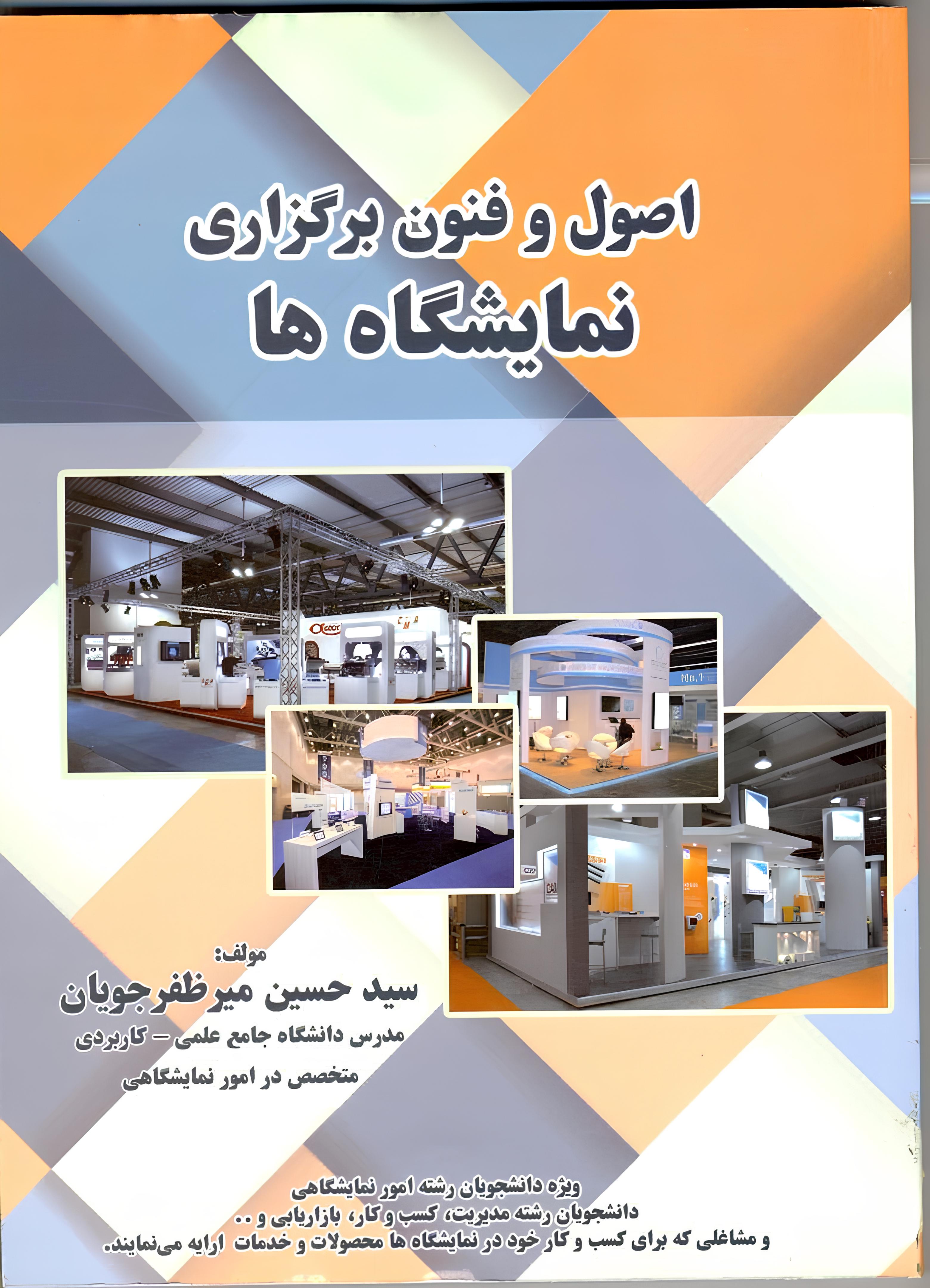
Introduction to the Book *Principles and Techniques of Organizing Exhibitions*
The book *Principles and Techniques of Organizing Exhibitions* was written by Seyed Hossein Mirzaffarjuyan. This book is a guide for those who want to organize an exhibition. This book accompanies you step by step.
About the Book *Principles and Techniques of Organizing Exhibitions*
Today, although exhibitions are increasingly used as places for marketing and business development, more important than the economic dimension of an exhibition is its communicative dimension, which, like a communication channel, functions to convey concepts, information, and awareness to message recipients. Therefore, it can be claimed that exhibitions, in addition to having commercial functions, also possess cultural, political, and even social functions, and play an effective role in the political, economic, social, cultural, and artistic spheres of nations. All countries of the world assign an important and multidimensional mission to exhibitions and pay great attention to exhibitions around the world, investing and making regular and continuous efforts to benefit from them as much as possible.
The effectiveness of exhibitions in countries' economic planning is clearly evident, and they are a full mirror for correcting, strengthening, and improving methods and facilitating commercial communications, accessing different markets, and boosting trade exchanges. Holding trade exhibitions is a means of achieving export development goals. Therefore, the role of marketing activities is extremely effective for their success, and by observing marketing principles and understanding markets, along with proper planning, exhibitions can make an effective contribution to promoting international trade and maintaining an active and extensive presence in the field of commercial and international exchanges.
The book *Principles and Techniques of Organizing Exhibitions* helps the reader be able to approach organizing an exhibition with a broader view and manage it in the best possible way.
To Whom Do We Recommend Reading the Book *Principles and Techniques of Organizing Exhibitions*
We recommend this book to everyone who intends to organize an exhibition.
An Excerpt from the Book *Principles and Techniques of Organizing Exhibitions*
Iran's economy has always depended on oil production and exports in terms of earning foreign currency income. Due to oil price fluctuations in past programs, the amount of oil reserves and the country's ability to export it, the policy of replacing oil exports with non-oil exports in order to supply the country's needed foreign currency has received more attention than ever before.
What is particularly important at this stage is the selection and proper management of available foreign exchange and non-foreign-exchange resources in the circulation of the country's production affairs, and more precise and rational planning and organization of the labor force and other factors of production in order to produce as many goods and services as possible with higher quality and the possibility of offering them in global markets. In addition, the marketing of produced goods is also of particular importance. Of course, in this regard, the structural problems of Iran's economy and the presence of capable competitors who are active in global markets should not be forgotten. Therefore, recognizing potential global markets for domestically produced goods and introducing produced goods to the aforementioned markets are among the most important points in advancing non-oil export policies as much as possible. In this regard, whatever can help the development of non-oil exports must be considered by policymakers, planners, and economic actors. One of the important tools for revitalizing exports and carrying out effective activities in advertising and marketing goods and services is exhibitions. In this regard, exhibitions, especially international exhibitions, enjoy a privileged position. Such events are multidimensional assemblies and pursue multiple political, economic, social, and cultural goals, and play the highest role in international trade. Such a prominent role is rooted in history, and its stages of evolution can be traced over the centuries.
If you wish, you can obtain this book from the link below.